 Back
Back
Nour Shantout
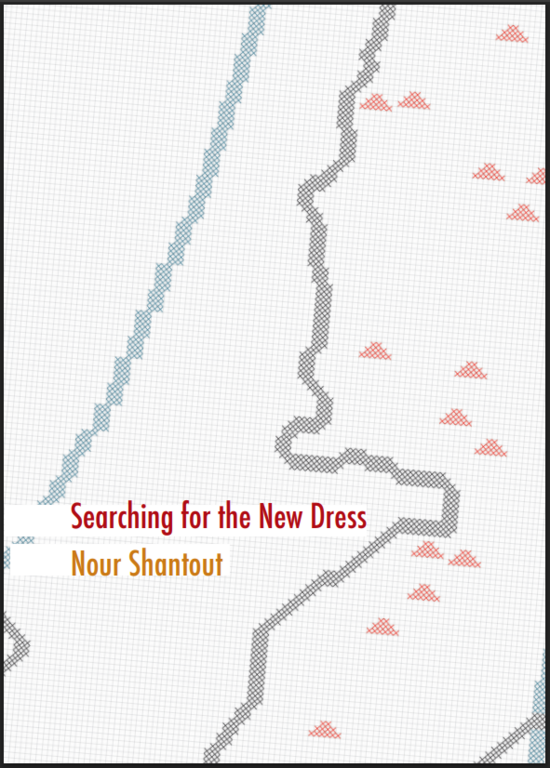
Searching for the New Dress
Download the Searching for the New Dress booklet!
The ‘Camp Dress’ or the ‘New Dress’ is a Palestinian embroidered dress which emerged when women from all over Palestine were suddenly mixed within camps in the neighboring countries, namely Jordan, Syria, and Lebanon, during the aftermath of the 1948 Nakba. The researcher, collector and historian Widad Kamel Kawar named the ‘New Dress’, which was “born of camp life and resistance”. Very little was written about it, and even Kawar ignored it for many years. The ‘New Dress’ was made with cheap materials, the locally woven textile of the traditional peasant dress was replaced by factory manufactured fabric. Women did not have so much time to embroider, so machine embroidery started to replace hand embroidery. Moreover, the embroidery motifs which were specific to each village started to mix, as women were inspired by their neighbours’ embroidery traditions and by the new place.
With the emergence of ‘The New Dress’, embroidery started to turn from ‘labour of Love’ to ‘labour’. Due to the loss of land and the inability to work in agriculture, many women who needed an income in the new place – the camp – made hand embroidery their profession.
This is how embroidery turned from an activity which is done at home in free time to labour and the dresses started to move from the bodies of the peasants to the bodies of the urbanites, who could afford wearing these dresses. That is when wearing these hand embroidered costumes became a political statement, and a way of mapping the lost land.
Searching for the New Dress looks at Palestinian embroidery in Shatila, a Palestinian camp in Lebanon. It explores how embroidery is influenced by the migration of Syrian Palestinian and Syrian women who took refuge there after the war in Syria. To create ‘New Dresses’ that reflect the socio-political, economic and demographic changes in the embroiderer’s life in the aftermath of the Syrian revolution (2011), I learned to design new motifs and types of stitches which are usually associated with Syrian and Palestinian embroidery. The research also involves interviews with embroiderers in various embroidery centers in Shatila, identifying designs that reflect the changes in Palestinian embroidery. The project asks, what if a ‘New Dress’ emerges after the Syrian revolution, the destruction of the Yarmouk camp – the capital of the Palestinian diaspora –, and the displacement of thousands of Syrians? What would it look like? Which fabric, colours, threads and techniques would be used? Which political slogans and maps would it have?
This project was produced thanks to the generous support of AFAC, Culture Resource and Minuseins.
The pictures are by © Leonhard Hilzensauer
© Nour Shantout
(source: nourshantout.com)
Back